
TL;DR
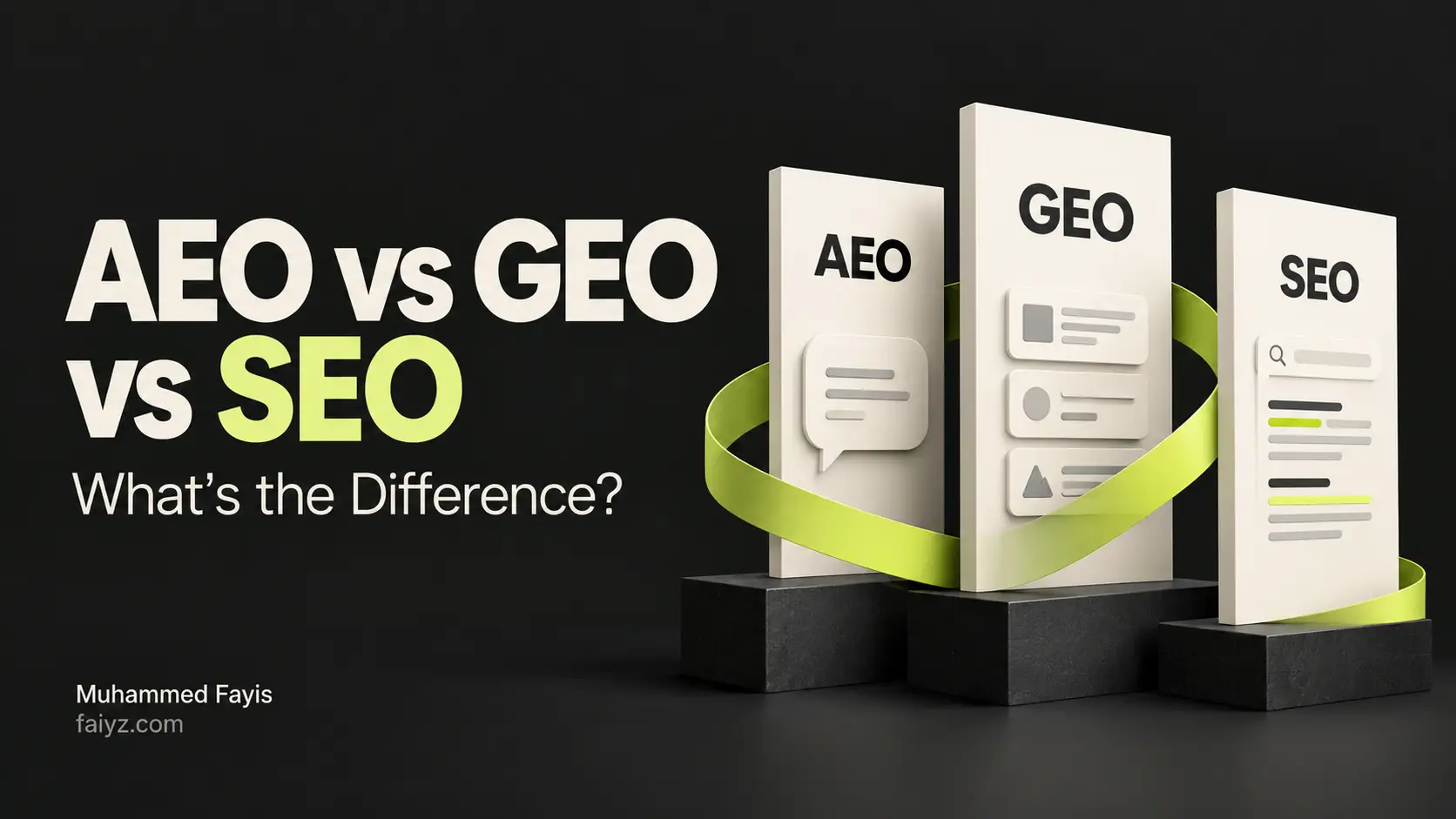
SEO improves how people find your website through search engines. AEO focuses on making your information useful as a direct answer. GEO focuses on how your information appears in generated answers.
These approaches overlap. One useful page can support all three.
For most businesses, start with a sound website and useful content. Then improve your answers, evidence, and measurement. You do not need three separate websites or copies of the same article.
Table of Contents
Introduction
Your website ranks for relevant searches. But does that mean Google will use it in an AI Overview? Will another search assistant cite the same page?
Those questions explain why marketers discuss AEO and GEO alongside SEO. The challenge is deciding what work these terms actually require.
The distinction affects your content, technical priorities, and reporting. It should help you choose useful changes and assess the services someone offers.
Google recognizes AEO and GEO as industry terms. However, it considers optimization for its generated search experiences part of SEO.
This guide compares their practical focus, shows where they overlap, and explains what I would prioritize for a UAE business.
Why the Difference Matters
You want more customers to find your business. Then someone tells you that SEO is no longer enough.
You also need AEO. And GEO. Possibly another service with another report.
Before you spend money, establish what work those labels describe.
The AEO vs GEO distinction is useful when it helps you identify a task. It becomes less useful when the terminology hides the task.
Google takes a clear position. It recognizes both terms, but considers optimization for its generated search experiences part of SEO. Google’s optimization guide
In this article, I use the terms to describe different areas of focus. The boundaries are practical, not fixed rules shared by every platform.
AEO vs GEO vs SEO at a Glance
| Area | SEO | AEO | GEO |
|---|---|---|---|
| Full name | Search engine optimization | Answer engine optimization | Generative engine optimization |
| Main focus | Search discovery and useful visits | Clear answers to specific questions | Accurate representation in generated answers |
| Typical work | Technical fixes, content, internal links, and authority | Definitions, instructions, comparisons, and relevant FAQs | Evidence, detailed information, source clarity, and brand consistency |
| Possible appearance | Organic results, local results, and other search features | Featured snippets and answer-based experiences | Supporting citations, source links, and brand mentions |
| Main limitation | Visibility does not guarantee a visit or sale | A clear answer does not guarantee selection | A citation does not guarantee traffic or a recommendation |
These are areas of emphasis. Clear answers also improve ordinary service pages. Technical problems can affect content intended for generated answers.
What SEO Still Controls in an AEO and GEO Strategy
If you already understand SEO, the useful question is what changes when the target includes generated answers.
Start by separating eligibility from selection.
Eligibility concerns whether a system can access and use your page. Selection concerns whether it chooses that page for a particular response.
For Google’s AI Overviews and AI Mode, supporting pages must be indexed and eligible for a search snippet. Meeting those requirements does not guarantee selection. Google’s eligibility guidance
That makes familiar SEO checks relevant:
| Check | Why it matters |
|---|---|
| Access and indexing | Important content must be available to the search system. |
| Internal links | Related pages need a clear, discoverable connection. |
| Page focus | The page must address a defined customer need. |
| Content accuracy | Product, service, and business details must remain reliable. |
| Landing-page experience | Visitors need a useful destination after following a link. |
AEO and GEO bring different questions to that foundation. They do not remove the need to maintain it.
Ranking Is One Signal, Not a Complete Diagnosis
Suppose your service page ranks well but rarely appears in the generated answers you monitor.
That observation does not identify the cause.
Review which sources appear instead. Examine the information those sources provide. Check whether your page answers the relevant question fully and accurately.
For example, your page might describe a website redesign service without explaining when a rebuild is necessary. A comparison question needs that distinction.
The useful change could be a better explanation, supported by examples. It might not require another page.
Likewise, an article can attract citations but produce few enquiries. That calls for a review of its audience, offer, and next step.
My SEO work in Dubai considers both discovery and what happens after the visit. A visibility improvement is more useful when the page helps a potential customer make a decision.
What Is AEO?
Answer engine optimization focuses on making information useful when a system needs to answer a question.
The practical work often starts with questions that customers already ask.
For example:
- What does your service include?
- How long does the work take?
- What information must the customer provide?
- Which option fits a particular need?
- What affects the final cost?
AEO encourages you to answer those questions clearly. It does not require every page to become a list of short definitions.
Example of AEO in Practice
A customer asks, “What does website maintenance include?”
A weak answer says that the business provides complete website solutions.
A useful answer names the work. It explains whether maintenance includes updates, backups, security checks, content changes, and technical support.
It also identifies exclusions.
That answer helps someone compare services. A search system might also find it useful when responding to the question.
Featured Snippets Are One Possible Appearance
Google’s featured snippets show the descriptive part of a search result before its title link. Google decides which pages qualify.
You cannot mark a page as a featured snippet or force its selection.
This is why I would avoid an AEO plan built around a supposed ideal answer length.
Use enough words to answer the question accurately. A simple definition needs less detail than a buying decision.
What Is GEO?
Generative engine optimization focuses on how your content and business appear in generated responses.
A response might mention your business, use information from your article, or link to your page as a supporting source.
Those outcomes differ.
A source citation does not necessarily recommend your company. A brand mention does not establish that anyone visited your website.
GEO work therefore needs clear goals. “Increase visibility” is too broad unless you define the relevant questions and desired appearance.
Example of GEO in Practice
Imagine someone asks for help choosing an ecommerce platform for a UAE business.
Useful supporting information could include:
- Payment requirements.
- Product catalogue needs.
- Language support.
- Delivery arrangements.
- Maintenance responsibilities.
- Limits of the available options.
A page that explains these decisions gives the system specific information to work with.
A page that only says “we provide the best ecommerce websites” gives the reader much less.
What GEO Research Actually Shows
The original GEO paper reported gains of up to 40% in response visibility under its test conditions.
That figure describes its visibility measures. It does not mean a business should expect 40% more website traffic or sales.
The study used defined engines, source sets, and queries. Its findings need that context.
Treat research findings as evidence to examine. Do not turn them into promises for every website.
How AEO, GEO, and SEO Work Together
One page can address all three goals.
Consider an article that compares website redesign with a complete rebuild.
Its SEO work helps the page become discoverable. Its clear explanations support direct questions. Its detailed comparisons provide information that generated responses could reference.
The page does not need three different versions.
Google explains that AI Overviews and AI Mode can search related subtopics when developing a response. This process is sometimes called query fan-out.
For the reader, the implication is straightforward: cover the decisions within the topic properly.
Do not publish a thin page for every possible wording of the same question.
A Practical Example for a Dubai Business
Consider a hypothetical air-conditioning maintenance company.
It serves specific areas of Dubai and wants more suitable enquiries.
Its SEO Priorities
The company needs clear service pages and accurate coverage information.
Customers must be able to find the business and understand whether it serves their location.
For local discovery, Google recommends complete and accurate Business Profile information. Local results also depend on factors such as relevance, distance, and prominence.
A new acronym does not remove those requirements.
Its AEO Priorities
The company needs to answer practical questions:
- What does a maintenance visit include?
- Is cleaning included?
- How does the customer book?
- Which problems require a separate inspection?
The answers need to reflect its actual service.
A generic FAQ copied from other companies could create incorrect expectations.
Its GEO Priorities
The company needs consistent, specific information that supports accurate representation.
Its website should distinguish routine maintenance from emergency repair. Its service area and contact details should agree across relevant profiles.
Useful photographs, documented procedures, and genuine customer feedback can help people assess the company.
The company still needs to measure enquiries. Appearing in an answer is only one part of the customer journey.
What Should Your Business Work on First?
I would choose the work according to the problem.
| Current problem | First priority |
|---|---|
| Important pages are inaccessible | Investigate technical SEO |
| Visitors cannot understand the service | Improve the service page |
| Customers repeatedly ask the same questions | Add clear answers |
| Content contains unsupported claims | Strengthen the evidence |
| Public business details conflict | Correct the information |
| Visibility increases without enquiries | Review the landing page and contact process |
| Reports combine different traffic sources | Improve measurement |
This approach keeps the work concrete.
You can assess whether someone fixed an indexing problem or improved a service explanation. “We optimized your GEO” needs more detail.
1. Check Access and Indexing
Use Search Console to inspect important pages.
Google’s minimum technical requirements include access for Googlebot, a successful page response, and indexable content. Meeting them does not guarantee indexing.
For supporting links in Google’s generated search features, pages must also be indexed and eligible for a search snippet.
2. Answer the Main Question Early
Start each section with the information its heading promises.
If the heading asks what a service includes, name the included work. Explain exceptions after the main answer.
Do not make the reader pass through a company introduction before finding basic information.
3. Add Evidence That Helps a Decision
Use evidence where it supports the explanation.
That might include a genuine project example, a product demonstration, an original photograph, or a source for an important claim.
Google’s content guidance asks whether a page offers original information, useful analysis, and clear evidence of expertise.
For a UAE audience, practical details can be especially useful.
State actual service coverage. Explain pricing assumptions in AED where appropriate. Identify which language options you provide.
Add these details because customers need them. Do not insert Dubai into every paragraph.
4. Connect Related Information
Link a broad guide to a relevant detailed explanation.
For example, a comparison article can link to the service that carries out the work. A service page can link to a useful process guide.
The anchor text should tell readers what they will find.
Internal links should make the next question easier to answer.
5. Keep Structured Data Accurate
Structured data uses a standard format to describe page information. Google uses it to understand content and support eligible search features.
Use markup that matches the visible page.
Google also says there is no special schema requirement for its generated search experiences. It does not use llms.txt to improve Google Search visibility. Google’s optimization guidance
Do not treat a plugin installation as proof that the content is now ready to appear in every assistant.
How to Measure SEO, AEO, and GEO
Keep exposure, website activity, and business outcomes separate.
Search Visibility
Use Google Search Console to examine relevant pages, queries, impressions, and clicks.
For AI Overviews and AI Mode, Google now provides a dedicated Generative AI performance report. Its documented data focuses on impressions.
My guide explains how to track AI Overviews and AI Mode in Search Console in more detail.
Generated-Answer Citations
Bing Webmaster Tools provides AI Performance reporting for supported experiences, including Copilot and Bing’s generated summaries.
Its citation measures show referenced content. They do not represent website clicks or sales. The data is aggregated and does not capture every appearance.
Website Visits and Enquiries
Use GA4 to examine recorded visits and important website actions.
Its AI Assistant channel covers recognized assistant traffic. Google AI Overviews and AI Mode traffic remain under Organic Search.
Then check completed enquiries, bookings, or purchases.
A rise in citations alongside more sales is encouraging. It does not, by itself, establish that those citations caused the sales.
Questions to Ask Before Paying for AEO or GEO
Ask a provider to describe the actual work:
- Which pages will you review?
- Which customer questions matter?
- What evidence supports your recommendations?
- Which technical changes are necessary?
- How will you record completed changes?
- Which reports will measure progress?
- What will the reports fail to capture?
Look for answers that you can inspect.
A useful proposal identifies pages, tasks, deliverables, and reporting limits. It also explains how the work supports your customers.
If you need help choosing priorities, my digital marketing consultation starts with the business problem and available evidence.
Frequently Asked Questions
Is GEO Replacing SEO?
No. Google’s generated search features still use its search systems and indexed content.
For a business, technical access and useful pages remain important. GEO adds a particular focus on representation in generated answers.
Is AEO Only About Voice Search?
No. In this guide, AEO includes clear answers across text-based and other answer experiences.
The useful question is whether the information answers the customer’s need.
Is an AI Overview an AEO or GEO Result?
It can fit both areas of focus.
It answers a question and generates a response with supporting information. The label matters less than the specific work and measurement.
Do FAQs Improve AEO?
Relevant FAQs help readers find answers.
They do not guarantee a featured snippet, a citation, or a generated-answer appearance. Include questions that your customers actually need answered.
Do I Need Separate Pages for SEO, AEO, and GEO?
Usually, no.
One accurate, useful page can support several discovery experiences. Create separate pages when readers have distinct needs, not merely because the acronyms differ.
Choose the Work That Helps Customers Find and Understand You
The useful difference between AEO, GEO, and SEO is the task each helps you examine.
SEO addresses discovery. AEO draws attention to the quality of your answers. GEO examines representation in generated responses.
Start with five important pages. Check access, unanswered questions, evidence, internal links, and the next step for visitors.
Then record what you change and review the results.
I am Muhammed Fayis, a digital marketing freelancer based in Dubai. My AI search optimization services connect this work with your wider search strategy.
If you need a clear starting point, contact me to discuss your website.